
Nearly 1 in 6 couples in India struggles to conceive, but for most women, the journey does not begin with answers; it begins with confusion.
A few months of trying quietly turn into a year, and suddenly, you are holding reports filled with terms like AMH, FSH, AFC, and HSG, without truly understanding what they mean.
In fact, infertility is more common than most people realise; around 1 in 6 adults globally experience it at some point, according to the World Health Organization. Yet, despite how widespread it is, clear guidance is still missing.
The challenge is not a lack of effort, but the absence of direction on which tests to take, when to take them, and how to interpret results, especially when reports appear normal, yet conception still doesn’t happen.
This guide will help you understand fertility testing step by step, so you can move forward with confidence and direction.
Why Fertility Testing Feels Overwhelming
Most women do not lack information about fertility testing. They have too much of it, from too many sources, pointing in too many directions, with no framework to make sense of any of it.
Lack of a Clear Starting Point
Every clinic runs a different panel. Every article recommends something slightly different. One friend started with AMH. Another went straight for an ultrasound. A third spent six months testing before anyone checked whether she was actually ovulating.
The result is a woman who is not uninformed; she is overwhelmed. She does not know which test to start with, which results should concern her, or which she can safely set aside. That confusion is not her fault. It is a gap in how fertility testing is typically explained.
Impact of Stress During Fertility Planning
It does, more than most people realise. When a woman is already anxious about conceiving, every test feels loaded. A flagged result sends her into panic. A clear report raises a new fear: if everything is fine, then why is it not happening?
In Ayurveda, chronic anxiety aggravates Vata dosha, which directly disturbs Apana Vayu, the force regulating the reproductive cycle. The emotional and the physiological are not separate. Getting clarity through structured testing is itself part of the treatment.
How Unstructured Testing Delays Diagnosis
A woman gets an AMH test because she read about it. A thyroid test because her cousin suggested it. A pelvic ultrasound six months later. Each test is done in isolation, at different cycle points, with no connecting picture.
Fertility testing is not a menu. It is a diagnostic sequence where each result builds on the one before. Done in the right order, they tell a complete story. Done randomly, they produce more questions than answers.
Now that you understand why confusion happens, the more important question is, when is the right time to actually start?
When to Consider a Fertility Check?
Timing your first fertility assessment is one of the most important decisions in the conception journey. Most women either go too late or test randomly without knowing where to begin.
Age-Based Fertility Evaluation Guidelines
| Age Group | Guideline | What It Actually Means |
| Under 35 | Try 12 months before testing | Only if cycles are regular and no risk factors exist |
| 35 to 37 | Seek evaluation after 6 months | Reserve declines faster; earlier testing preserves options |
| 38 and above | Evaluate as soon as possible | Time is the most significant factor; do not wait |
| Any age with symptoms | Test now | Irregular cycles, PCOS, thyroid issues change everything |
At Ojas Ayurved, we approach this differently. Ayurveda recommends preparing the body before conception, not just diagnosing after failure. Testing early is preparation, not panic.
Early Signs That Require Immediate Testing
Do not wait for the 12-month mark if any of the following apply right now: irregular or absent periods, diagnosed PCOS, thyroid condition, even if managed, history of miscarriage, pelvic infections or endometriosis, unexplained hair fall or weight changes alongside cycle irregularity, or a partner with known fertility concerns.
Any single item on this list is reason enough to seek evaluation now.
Delaying Testing Can Cost You Time
Delaying the right evaluation often reduces the options available over time. Women who delay testing often discover their situation would have been far more manageable a year earlier, not because treatment becomes impossible, but because options narrow with time. The emotional toll matters too; months of uncertainty without answers can be exhausting.
Knowing when to test is half the equation. Understanding what the evaluation actually involves is what prepares you to go through it confidently.
Fertility Evaluation Process and Test Preparation
A fertility evaluation is not a single appointment. It is a structured process that unfolds across one menstrual cycle, and knowing what to expect makes the entire experience far less intimidating.
Initial Clinical Assessment Before Testing
Before a single test is ordered, the process begins with a detailed discussion with Fertility Experts, and this is the most clinically important part of the process.
A doctor covers your cycle length and regularity, pregnancy history, including any miscarriages, past infections or surgeries, current medications, lifestyle factors like sleep and stress, and your partner’s health history.
At Ojas Ayurved, this consultation also includes a Prakriti assessment, evaluating your body constitution to determine whether you are predominantly Vata, Pitta, or Kapha.
This shapes every treatment recommendation that follows. No two women with the same AMH level receive the same plan.
Recommended Testing Sequence for Accurate Diagnosis
A structured fertility evaluation always follows a logical flow rather than a fixed checklist. It usually begins with basic hormonal testing early in the cycle, followed by an ultrasound to understand structural health.
Ovulation is then confirmed within the same cycle, and only if required, further tests are added. When this sequence is followed correctly, each result builds on the previous one, creating a clear and complete picture instead of isolated findings.
Preparing for Reliable Test Results
Preparing for fertility tests is just as important as taking them. Many hormonal tests depend on specific days of your menstrual cycle, and even small factors like stress, lack of sleep, or physical exertion can influence results.
Ensuring proper timing and a calm physical state helps avoid misleading readings and repeated testing. When tests are done under the right conditions, they provide a far more accurate picture of your reproductive health.
With the process clear, the real substance begins: the seven tests every woman should understand before walking into any clinic.
Top 7 Fertility Tests Every Woman Should Know About
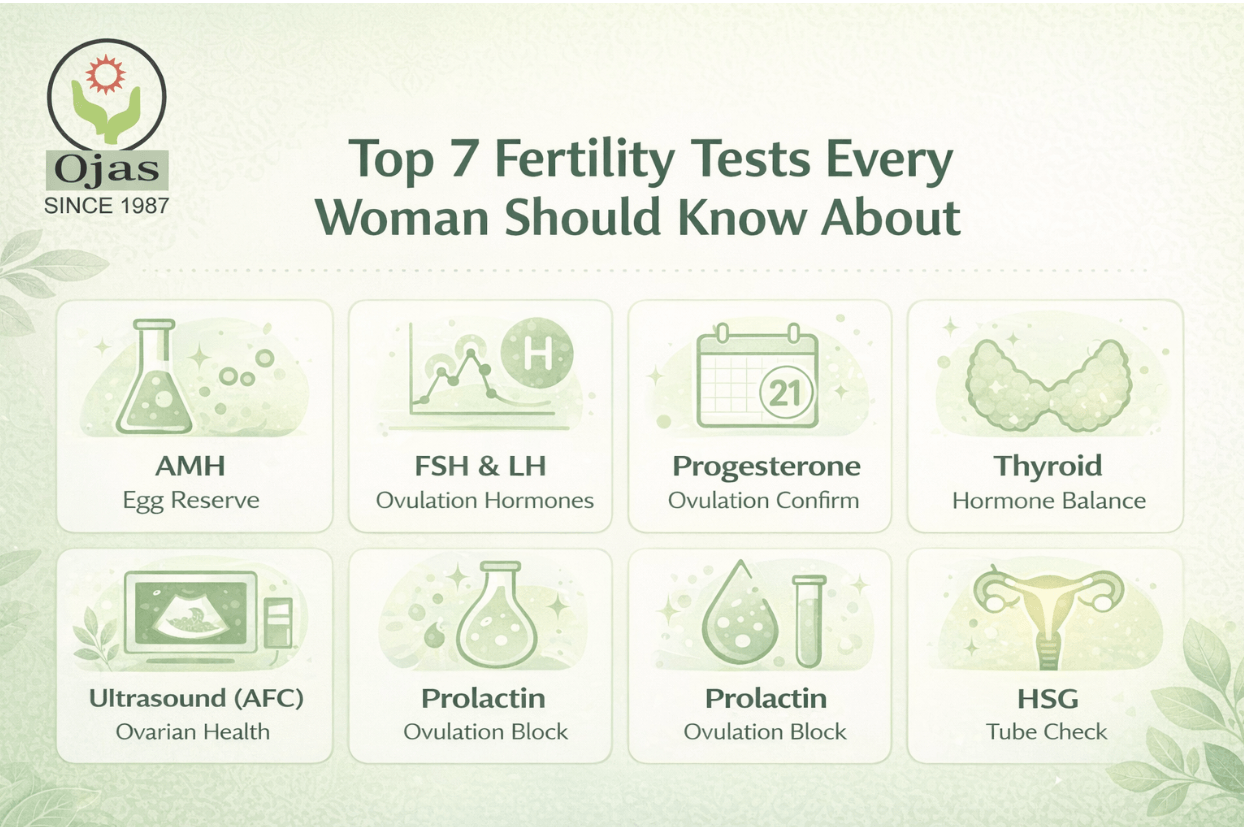
These seven tests form the most complete standard picture of female reproductive health. Each checks something different. Together, they tell a story no single test can tell alone.
AMH Test: Assessing Ovarian Reserve
The AMH test measures ovarian reserve, or the number of eggs remaining in the ovaries. It is often one of the first tests recommended because it can be done at any time during the cycle. However, it is important to understand that AMH reflects quantity, not quality.
A normal value does not guarantee healthy eggs, and a low value does not mean pregnancy is impossible. It simply indicates that timing and the right approach become more important.
FSH and LH: The Ovulation Hormones Explained
FSH triggers egg development each cycle. LH triggers the release of the mature egg. Both are tested on Day 3. High FSH signals that the ovaries are working harder than they should. High LH with elevated androgens is the hormonal fingerprint of PCOS.
The nuance most reports skip: FSH must always be read alongside Estradiol on the same Day 3 draw. High Estradiol artificially suppresses FSH, making it look normal when the picture is not. If your clinic tested FSH without Estradiol, that result alone may be misleading.
Day 21 Progesterone: Confirming Ovulation
This is the most important test most women have never had, and the one most frequently missing from standard panels.
Having a regular period every month does not confirm ovulation. Menstruation is the shedding of the uterine lining. Ovulation is the release of an egg.
They are two separate events, and one can happen without the other. A woman can have predictable, regular cycles and still not be releasing a viable egg every month.
Without ovulation, conception is impossible, even if other reports appear within range. One blood draw on Day 21 confirms whether it happened.
Thyroid Panel: The Hidden Hormonal Disruptor
The thyroid directly regulates ovulation, menstrual regularity, and the ability to sustain early pregnancy. Hypothyroidism is one of the most underdiagnosed conditions in Indian women; many carry it for years without knowing.
The number that matters for fertility specifically: the TSH threshold for conception is tighter than the general reference range on your lab report.
A result that does not trigger a lab flag may still be too high for conception. Always discuss the specific number, not just the flag status, with your doctor.
Thyroid antibodies (TPO and TgAb) go one step further. Even when TSH is normal, autoimmune thyroid disease can silently affect egg quality and implantation, particularly relevant in recurrent miscarriage.
Pelvic Ultrasound and AFC: Structural and Reserve Assessment
The transvaginal ultrasound gives the most immediate visual picture of reproductive anatomy, uterus shape, endometrial thickness, cysts, fibroids, polyps, and Antral Follicle Count. Results are on the spot.
AFC counts the small resting follicles visible in each ovary, each containing an immature egg. A low AFC alongside low AMH strengthens the picture of declining reserves. A high AFC with high LH points toward PCOS. No waiting. No follow-up appointment for results.
Prolactin Test: The Overlooked Ovulation Blocker
Prolactin is a hormone primarily associated with breastfeeding, but when elevated outside of pregnancy, it can suppress ovulation. Many women with otherwise normal reports experience irregular cycles due to this imbalance.
Because its symptoms often resemble stress-related disruptions, it is frequently overlooked. Identifying and correcting prolactin levels can resolve ovulation issues more easily than many expect.
HSG Test: Evaluating Tubal Patency
The HSG confirms whether the fallopian tubes are open and whether the uterus has a normal internal shape. Blocked tubes mean egg and sperm physically cannot meet, regardless of how perfect every other report looks.
What to expect: mild cramping during and shortly after, comparable to stronger period pain. The procedure takes under 30 minutes. Most women return to normal activity the same day.
This is not a first-line test for everyone; it is ordered when tube issues are suspected from history or when a clear first-layer panel has not resulted in conception despite confirmed ovulation.
These tests show where things stand, but they do not explain the complete picture. There is a deeper layer that no standard panel reaches, and for many women, that is exactly where the answer lies.
What Your Fertility Reports Are Not Telling You
Fertility reports focus on measurable factors, but they do not capture the complete picture of reproductive health, often missing deeper influences like egg quality, metabolism, and overall body balance.
Everything Looks Normal, but Pregnancy Isn’t Happening
This is where most women feel stuck, not because nothing is wrong, but because the underlying issue isn’t being measured.
Standard fertility tests assess hormone levels and reproductive structure, but they do not capture egg quality, uterine receptivity, or the deeper impact of stress and metabolism. This is why reports may appear normal while conception still doesn’t happen.
Ayurvedic Perspective on Fertility Assessment
At this stage, the question shifts from “Which test is left?” to “What is being missed entirely?” Ayurveda evaluates fertility by looking at the body as a whole, including digestion, hormonal rhythm, and reproductive strength.
These internal factors influence conception directly, yet they are not reflected in standard lab reports, which focus only on measurable parameters.
Role of Agni, Doshas, and Artava Dhatu in Fertility
In Ayurveda, fertility depends on how efficiently the body converts nutrition into healthy reproductive tissue. This process is governed by Agni (metabolism), balanced Doshas, and the strength of Artava Dhatu.
When this internal system is disrupted, ovulation or implantation may not occur effectively, even if all medical reports appear normal.
Have questions your reports didn’t answer? Book your free Tuesday consultation at Ojas Ayurved and get a clear, personalized path forward.
When reports reach their limit, expert interpretation is what opens the next door.
Why Expert Guidance Matters More Than Additional Testing
More tests without expert interpretation do not bring answers. They bring more data, and without context, data is just noise.
How to Interpret Your Fertility Reports Correctly
The real insight lies in how results are interpreted alongside your age, symptoms, and cycle patterns. Similar numbers can reflect very different underlying issues.
When reports are read in isolation, key connections are missed, often delaying the right treatment and prolonging the journey unnecessarily.
Importance of Evaluating Both Partners
Male factors contribute to nearly half of all infertility cases. Testing only the woman while her partner goes unevaluated is one of the most common causes of extended, unresolved infertility.
At Ojas Ayurved, both partners are assessed, sperm quality, motility, vitality, and the male constitutional picture are evaluated alongside the female fertility assessment.
A combined plan produces significantly better outcomes than treating either partner in isolation. Infertility is never only one partner’s issue.
Conclusion
Fertility testing works best when it follows a clear sequence rather than scattered decisions. Knowing when to test, what each result means, and how they connect can significantly improve your approach to conception. For a structured and personalized approach, book your free Tuesday consultation at Ojas Ayurved.
FAQ’s: Female Fertility Check
1. Which fertility test should I start with?
Most evaluations begin with basic hormone tests early in the cycle, followed by an ultrasound. The exact starting point depends on your age, symptoms, and cycle regularity.
2. Can stress really affect fertility?
Yes. Chronic stress can disrupt hormonal balance and ovulation. Over time, it may affect cycle regularity and overall reproductive health, even if initial test results appear normal.
3. How long does a fertility assessment take?
A complete basic assessment usually takes one menstrual cycle. Some tests are done on specific days, so timing naturally spreads the process across a few weeks.
4. Can fertility problems be detected early?
In many cases, yes. Irregular periods, hormonal imbalances, or underlying conditions can often be identified early through proper testing, helping you take timely action.
5. Where should I go for proper fertility testing?
Choose a place that focuses on structured testing and complete assessment, not scattered or unnecessary tests. Clinics like Ojas Ayurved also evaluate overall body balance alongside reports for better clarity.